- Research Travel Assistance Program
- Underrepresented Faculty Recruitment
- Endowed Chairs
- University Scholars Program
- President's Award Program
- Distinguished Faculty Recruitment Program
- Arts & Humanities Integration Initiative
- Oped Project Public Voices Fellowship
- Humanitarian Award
- Gender Inclusive Leadership Council
- Early Childhood Education

University of Illinois System
Arts & Humanities Integration Initiative
The University of Illinois System introduced a three-year Arts & Humanities Integration Initiative in Fall 2026 to seed high-impact projects that place arts and humanities methods and creative practice at the core of interdisciplinary teaching, research, and public engagement. The Initiative will fund a focused annual call (one theme per cycle) with clear expectations for meaningful integration, deliverables, and sustainability—while leveraging existing campus assets and a light-touch governance model.
Please Note: The Arts & Humanities Integration Initiative Committee is in the process of finalizing the framework and implementation details for this new initiative. Information about the Call for Proposals, including eligibility, timelines, and submission requirements, will be posted once available. Please check back for updates.
Objectives
- Demonstrate and communicate the distinctive public and academic value of arts and humanities scholarship and creative practice.
- Catalyze a small number of exemplary, visible projects each year in which arts and humanities are integral from project conception.
- Strengthen pathways to external funding and/or durable institutional adoption (curricular, programmatic, or partnership-based).
- Expand opportunities for students to engage in purposeful creative and humanistic experiences connected to real-world challenges and communities.



Rationale
Arts and humanities funding opportunities—particularly at the federal level—are modest compared to other major research agencies, and awards often require significant compliance effort. At the same time, arts and humanities approaches strengthen research and teaching across disciplines by improving interpretation, ethics, communication, design, historical context, and public trust. This Initiative is designed to invest strategically in a small set of high-leverage projects that can be scaled, sustained, or positioned for external support.
Design Principles
- Focus: Each annual cycle emphasizes one broad theme but projects outside the theme would still be considered.
- Meaningful integration: Projects must demonstrate arts/humanities centrality in aims, methods, and outcomes.
- Low overhead: A small System Steering Group and a time-limited review panel reviews and selects projects based on a set of criteria.
- Leverage what exists: Build on current campus strengths and units (e.g., humanities institutes, arts integration offices, colleges, libraries, museums).
- Sustainability: Proposals should address a plan for sustainability of impact (examples might include external funding, curricular adoption, partner co-investment, or ongoing home unit support).





Program Structure
Annual Call: One Theme, Two Funding Tracks
The System will issue one annual call organized around a theme (e.g., Health & Human Experience; Climate & Cultural Resilience; Ethics, AI, and Society; Democracy, Dialogue, and Civic Life). The call will support two complementary tracks:
- Track A – Integrated Project Seed Grants (4–8 awards): Interdisciplinary teams with arts/humanities at the core; expected outcomes include public-facing products, performances/exhibitions, prototypes, research outputs, and/or competitive external proposals.
- Track B – Course/Student Creative Experience Mini-Grants (8–15 awards): Small awards to embed arts/humanities experiences into existing courses or co-curricular learning (guest artists, community workshops, field-based creative practice, museum/performance engagement) with clear learning outcomes.
Both tracks emphasize cross-campus collaboration where it adds value, but awards may be single-campus or multi-campus depending on proposal strength.
Eligibility and Expectations
- Teams must include at least one tenure-system faculty member (or equivalent) in the arts or humanities; additional partners may include any discipline, staff experts (libraries/museums), and community organizations. While not required, collaboration with disciplines outside the arts and humanities and/or across universities is preferred.
- Proposals must articulate why arts/humanities approaches are essential to the project’s core questions and outputs.
- Deliverables must be concrete and time-bound (e.g., a public program/exhibition/performance series, digital product, curated archive, policy/ethics toolkit, educational module, external grant submission).
- Sustainability plan: proposals that identify a path to continue the work beyond seed funding (external funding target, institutional adoption, partner support) are preferred.
Funding Model
The Initiative is a three-year program with defined annual budgets and a mid-point assessment.
- System investment: $250K–$400K per year for three years.
- Maximum award sizes: Track A $25K–$75K; Track B $5K–$10K.
Governance and Administration
- System Steering Group (5–7 members): EVP/VPAA (or designee) chairs; one provost designee from each university; two to three rotating faculty co-chairs (arts/humanities and non-arts/humanities). Responsibilities: set annual theme, approve call language, confirm selection rubric, receive mid-year and annual reports.
- Time-limited Review Panel: constituted each year for proposal review (6–9 members, including EVP/VPAA designee, arts/humanities faculty, cross-disciplinary faculty, and a community partner where appropriate).
Selection Criteria
- Centrality of arts/humanities: integration is essential to aims/methods/outputs.
- Impact and visibility: credible public-facing or scholarly outputs; benefit to Illinois communities and/or the public.
- Interdisciplinary quality: complementary expertise; clear collaboration plan.
- Feasibility: appropriate scope, budget, timeline, and team capacity.
- Sustainability: credible continuation plan (external funding, adoption, partnership).
- Student opportunity: meaningful involvement of students and training benefits.
Timeline and Reporting
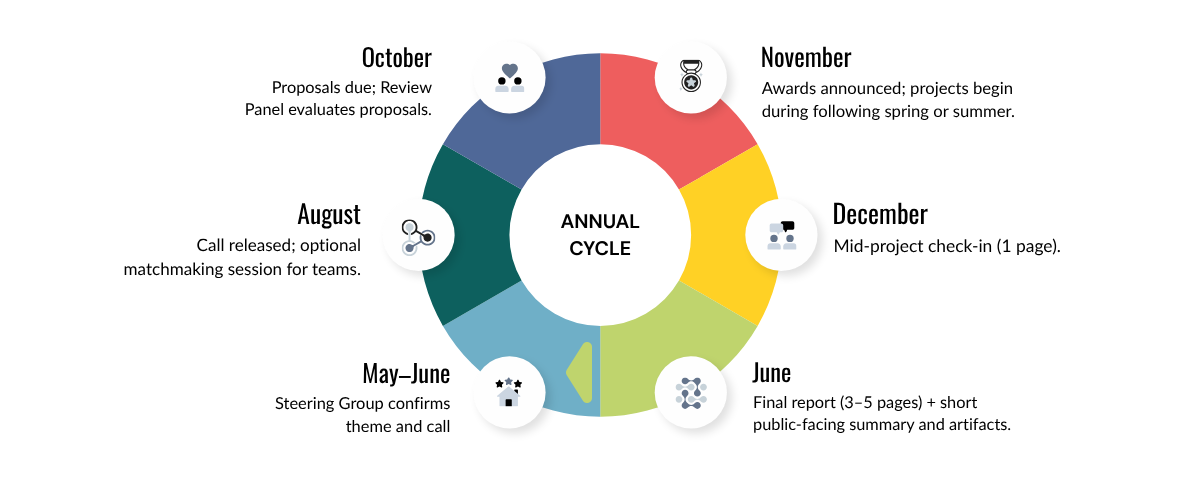
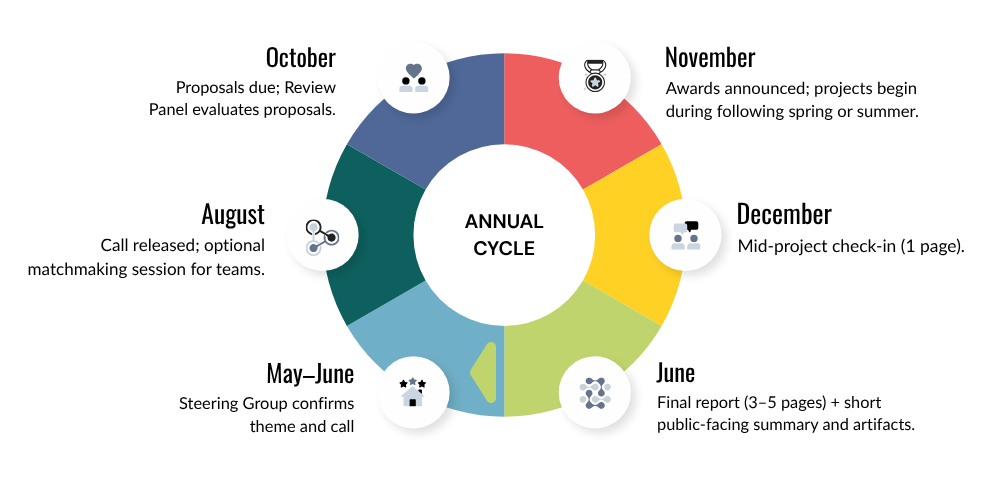
Annual cycle:
- May–June: Steering Group confirms theme and call.
- August: Call released; optional matchmaking session for teams.
- October: Proposals due; Review Panel evaluates proposals.
- November: Awards announced; projects begin during following spring or summer.
- December: Mid-project check-in (1 page).
- June: Final report (3–5 pages) + short public-facing summary and artifacts.
Success Measures
- Number and quality of funded projects; cross-campus and community partnerships formed.
- Public-facing outputs delivered (events, exhibitions, performances, digital resources) and participation/engagement.
- External funding submissions and awards attributable to seed support.
- Sustained adoption (courses, programs, partnerships) after seed period.
- Student participation, experiential learning outcomes, and evidence of skill development.
At the conclusion of Year 2, the System Steering Group will evaluate the program outcomes and make recommendations beyond the three-year term. The System Steering Group will also identify opportunities and make recommendations concerning how the program can be leveraged to encourage more collaboration between the arts and humanities and other disciplines across the system.